Newsletter Subscribe
Enter your email address below and subscribe to our newsletter
Enter your email address below and subscribe to our newsletter

 ByJohn A
Getting dressed for work should not feel like solving a puzzle. The right fabric, color, and draping approach means your hijab becomes part of the outfit rather than something you are constantly working around. Most issues that come up with professional hijab styling trace back to three things: fabric that shifts by midday, colors that do not coordinate with the rest of the look, or a drape that adds too much bulk at the neckline.
Here is a practical breakdown of how to handle each one.
The fabric you choose determines how the hijab behaves across an eight-hour day. It affects how much adjusting you need to do, how polished the hijab looks by midafternoon, and how much bulk it adds around the neckline of a structured outfit.
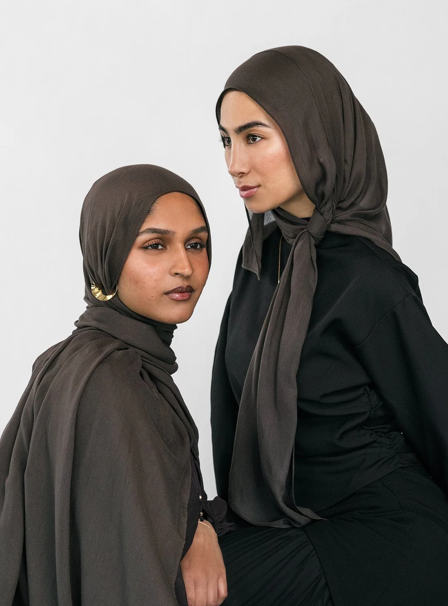
Modal is the strongest all-around work hijab fabric. It drapes smoothly against the face, holds its position through the day without slipping, and does not add weight or thickness at the shoulder. The smooth surface reads as clean in professional settings in a way that textured or heavy fabrics do not.
Modal hijabs sit close to the face with a fluid drape that suits blazers, structured collars, and button-down shirts without competing for space at the neckline. Jersey is a good secondary option for women who prefer a no-pin approach, because its knit structure grips without needing a complex setup. Chiffon is better reserved for formal occasions rather than daily professional wear, as it needs more maintenance throughout the day.
Color choice for work hijabs should follow the same logic as the rest of a professional wardrobe: neutrals and deep tones carry the most authority and require the least coordination effort.
The most reliable work hijab colors are charcoal, navy, slate, black, deep burgundy, and warm camel. These tones pair with most suit and blazer colors without introducing a color problem into the morning routine. A charcoal hijab with a grey suit reads as completely cohesive. A navy hijab with a white shirt and dark blazer is clean and deliberate.
Brighter colors and prints can work in professional settings, but they require a simpler outfit underneath. A floral or geometric print hijab in muted tones with a plain blazer and solid shirt is a considered look. A bright print over a patterned blouse is too much. The rule: the hijab is either the statement or the neutral, not both at the same time.
See also: What Students Should Evaluate Before Choosing a Loan App
The drape style has as much impact as the fabric or color. Loose, flowing wraps with multiple overlapping panels can look relaxed or informal in structured work environments. The draping techniques that read best in office settings are clean, flat, and minimal.
A single-layer wrap with one pin at the chin or shoulder keeps the fabric lying flat against the neckline and prevents the hijab from adding unnecessary bulk. The smoother the front surface of the hijab, the more it integrates with the rest of the outfit rather than sitting on top of it.
For women who prefer more chest coverage, a longer panel draped over the shoulder and secured with one flat pin reads cleaner than multiple wrapped layers. The key: each element of the drape sits in one position and stays there. A hijab that needs constant adjustment looks unfinished, regardless of how it starts in the morning.
The most efficient approach to professional hijab dressing is to choose the hijab first and build the outfit around it, rather than choosing the outfit and then hunting for a hijab that works.
Start with a neutral hijab in a fabric that suits the environment. A dark modal hijab in navy or charcoal works across most professional wardrobe colors. Then add the structured pieces: blazer, trousers, and a clean shirt or blouse underneath. The hijab and the structured clothing work together naturally when the hijab is already anchored as the starting point.
– Navy modal hijab + white button-down + navy blazer + tailored black trousers
– Charcoal hijab + grey blazer + cream wide-leg trousers + a fitted black top
– Camel modal hijab + camel structured coat + black trousers + a white shirt
– Deep burgundy hijab + black blazer + black trousers + a cream blouse
– Slate blue hijab + charcoal suit jacket + matching trousers + white shirt
Work hijab styling benefits from restraint in accessories. The hijab is already an element that the outfit needs to integrate. Adding heavy jewelry, large pins, or decorative accessories on top of a structured work look creates visual noise that undercuts the overall professionalism.
Fine gold or silver jewelry works well because it adds finish without competing. Small stud earrings or a simple bracelet are enough. Hijab pins should be flat and unobtrusive. A flat safety pin or a small straight pin is cleaner than a decorative brooch in most office environments.
Modal works well across most climates, but the weight and layering of the overall outfit shifts with temperature. In warmer months, a lighter modal hijab in a soft neutral over a single, structured layer is comfortable and professional without adding heat around the neck. In cooler months, the same hijab layered under a structured coat or over a knit layer reads as appropriate for the season without changing the quality of the look.
Avoid very heavy or thick hijab fabrics in warm office environments. A pashmina or heavy wool hijab worn indoors in a heated office feels uncomfortable throughout the day and can look out of place in a standard professional setting.
What is the best hijab fabric for a formal office environment?
Modal is the most reliable choice for formal office wear. It drapes smoothly, holds its position through the day without constant adjustment, and does not add bulk at the neckline of a structured outfit. The clean surface reads as professional across most business environments.
Can I wear a printed hijab to work?
Yes, with a solid and structured outfit underneath. A geometric or subtle floral print in muted tones works well in most offices when paired with a plain blazer and solid clothing. Avoid large, bright prints in very conservative professional environments, where a solid hijab is the safer and more versatile choice.
How many pins should I use for a professional hijab style?
One or two flat pins are enough for most work styles. One pin at the chin or jaw to secure the initial wrap, and one at the shoulder if the fabric needs anchoring there. More pins than that can distort the surface of the hijab and make the drape look uneven rather than clean.
What hijab colors work best across most professional wardrobe colors?
Charcoal, navy, slate, and deep burgundy are the most versatile because they pair with black, grey, white, and cream outfits without creating a color conflict. Camel works well with warmer-toned professional wardrobes. Black is the most neutral option because it pairs with virtually everything.
How do I keep a work hijab looking neat by the end of the day?
Start with a well-fitting cotton undercap, which prevents the hijab from shifting backward. Use a smooth, fluid fabric like modal rather than textured or loosely woven fabrics that crease and lose shape. Keep the drape simple and flat rather than layered, which reduces the number of points where the fabric can shift throughout the day.
Explore VELA’s modal hijab collection for smooth, work-ready styles that hold their shape through a full day of professional wear: velascarves.com/collections/modal-hijab